What Is the Aphantasia Test and How Does It Work?
The aphantasia test is a free online self-assessment that measures the vividness of your mental imagery — the famous "mind's eye." If you have ever wondered why some people seem to vividly daydream in full color while others think only in words and concepts, this free aphantasia test can help you place yourself on the visualization spectrum. Modeled after the VVIQ (Vividness of Visual Imagery Questionnaire), our online aphantasia quiz asks you to imagine sixteen everyday scenes and rate how clearly each one appears in your imagination.
Aphantasia is a recently named cognitive variation in which a person experiences little or no voluntary visual imagery. The term was coined in 2015 by neurologist Adam Zeman at the University of Exeter, and research suggests that roughly 1 in 25 people may have some form of it. Taking a structured aphantasia test online is one of the simplest ways to begin exploring whether your inner visual world differs from the cultural norm — and there is nothing wrong with whichever side of the spectrum you fall on. Many writers, scientists, and engineers report total aphantasia and consider it a creative asset, not a deficit.
The Mental Imagery Spectrum: From Aphantasia to Hyperphantasia
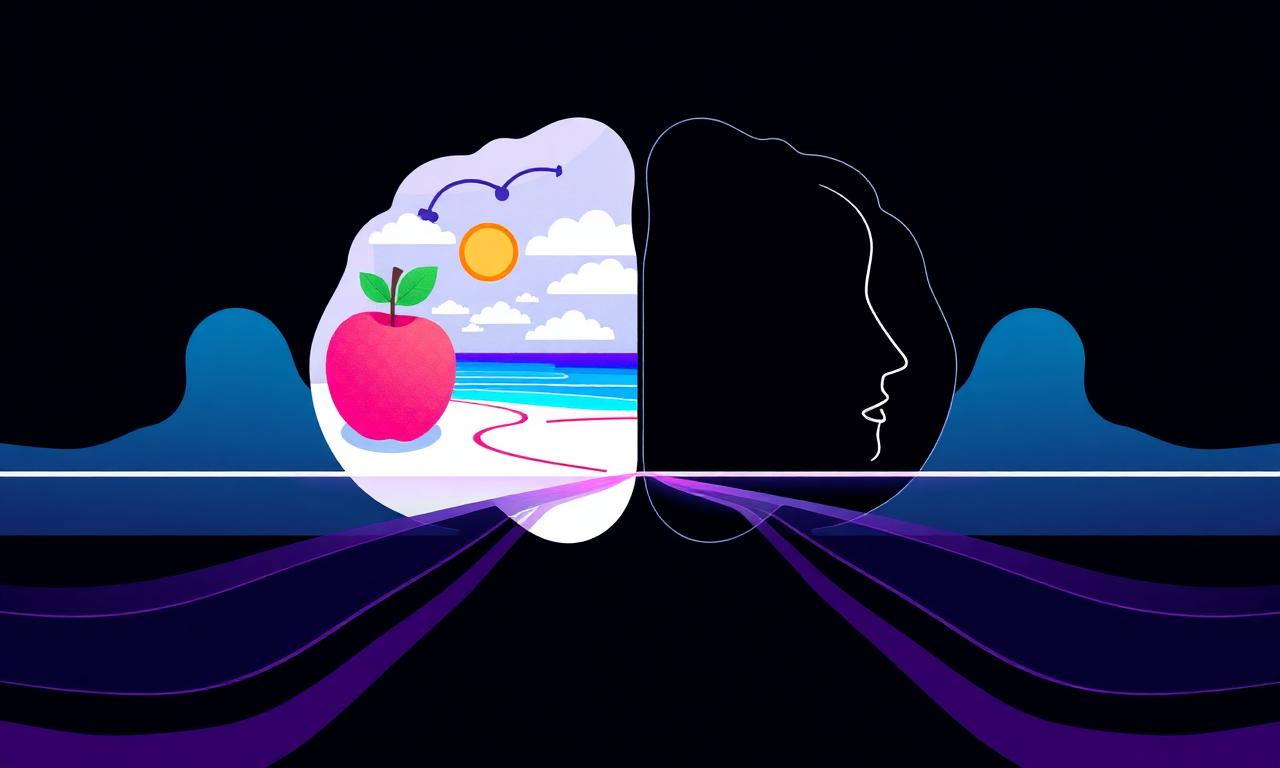
Mental imagery isn't binary. The results of a reliable online aphantasia test usually place you somewhere along a five-point continuum. On one end is aphantasia — no voluntary visual imagery at all. At the other end is hyperphantasia, where imagined scenes feel as clear and detailed as real sight. Most people land somewhere in the middle, with "typical" visualization producing scenes that are recognizable but not photographic. Our free online aphantasia test uses a 1–5 vividness scale across sixteen prompts, mirroring the standard VVIQ scoring used in cognitive research.
- Hyperphantasia (64–80): Imagery as vivid as real perception.
- Strong visualizer (48–63): Clear, colorful and detailed mental images.
- Typical (32–47): Moderately clear imagery, the cultural norm.
- Hypophantasia (23–31): Dim, vague mental pictures.
- Aphantasia (16–22): No voluntary visual imagery.
How the Free Online Aphantasia Test Works (Step by Step)
Taking the test is straightforward. You'll be shown sixteen familiar scenes — a friend's face, sunrise, a red apple on a table, your childhood bedroom — and asked to imagine each one as vividly as you can. For every prompt, you select one of five vividness options, ranging from "perfectly vivid, like real vision" to "no image at all, only knowing." The whole aphantasia test online takes about three minutes, runs entirely in your browser, and never stores or transmits your answers. You'll receive an instant score and a plain-English interpretation explaining where you fall on the imagery spectrum.
Why People Take a Free Aphantasia Test Online
People take a free aphantasia test online for many reasons. Some have just discovered the concept and are curious whether their inner experience matches the description. Others noticed during meditation or memory exercises that they "can't picture" things their friends describe in vivid color. Writers, designers and game developers use an aphantasia quiz to better understand how mental imagery shapes their creative process. Educators and therapists use the VVIQ-style format to help clients recognize that thinking in concepts rather than images is a normal cognitive style, not a flaw. Whatever your reason, a structured online aphantasia test offers a low-pressure first step toward self-understanding.
Aphantasia, Memory and Creativity: What Research Shows
Aphantasia does not mean lack of imagination. People with aphantasia often have full conceptual, semantic and emotional memory — they simply experience it without pictures. Many describe vivid dreams even when they can't visualize while awake, since dreaming uses different neural pathways. Some studies also report that aphantasic individuals are over-represented in STEM fields, possibly because abstract, language-based reasoning is highly efficient for problem-solving. Hyperphantasics, by contrast, often gravitate toward visual arts, design and creative writing. Neither end of the spectrum is "better" — they are simply different ways of thinking.
Is This Free Aphantasia Test a Clinical Diagnosis?
No. This free online aphantasia test is an educational, informational tool inspired by the VVIQ research instrument. It does not diagnose any medical or psychological condition. Aphantasia itself is not a disorder — it is a normal cognitive variation. If you would like a formal assessment, or if changes in your mental imagery are causing distress, please consult a qualified healthcare professional or cognitive psychologist. We built this test so anyone, anywhere, can explore their mind's eye for free, with no account, no email and no data collection.